
First check
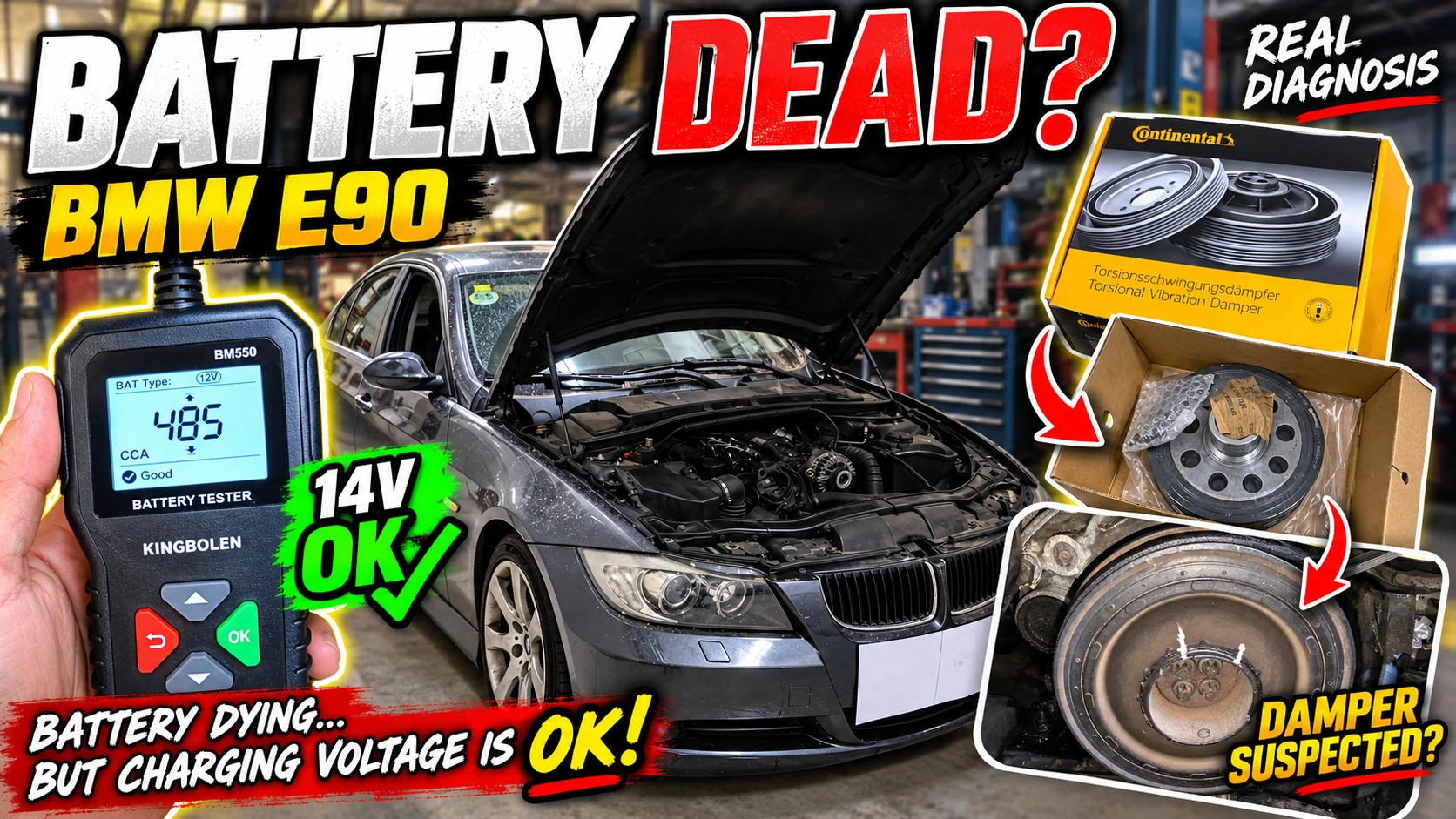
Measure the charging voltage
With the engine running we checked the voltage that the charging system was delivering.
The first measurement was carried out using the auxiliary terminals located in the engine compartment.
The result was approximately:
14 V
With that value, at that moment the alternator was charging correctly.
But we still had to check something important: the battery in this BMW is located in the trunk and we wanted to make sure that the voltage was also reaching it correctly.
Check directly on the battery
Did the 14 V reach the trunk?
We carry out a second measurement directly on the battery terminals.
The values remained around:
13.90 – 13.95 V
Therefore, at that time we not only had charging voltage in the engine compartment, but it also reached the battery correctly.
This indicated that the main wiring was transmitting voltage and that we did not have an obvious drop between the front of the vehicle and the battery.
Suspicion about the damper pulley
Could the crankshaft pulley be failing?
Even though the measurements were correct, we still had the owner's story: after about 20 km the car supposedly ended up discharging the battery.
One of the possibilities I considered was a problem in the crankshaft damper pulley.
If the pulley is damaged and stops correctly transmitting movement to the accessory belt, it could affect the operation of the alternator.
For that reason I decided to dismantle it and check its condition.
The initial diagnosis was incorrect
The damper pulley was in good condition
After disassembling the pulley I verified that it was not broken.
The damper was in good condition, so my initial suspicion was not confirmed.
And this is also part of a real diagnosis: not all hypotheses end up being the cause of the breakdown.
The important thing is to check them before replacing parts.
The definitive test
Do the same kilometers that the owner did
Since the fault, according to the owner, appeared approximately after traveling 20 kilometers, the next test had to be simple:
do those kilometers with the car and see what happened.
I traveled a little over 20 km, trying to reproduce the conditions in which the fault supposedly appeared.
During the entire trip the BMW worked correctly.
No warnings related to a lack of battery appeared, the electrical system did not begin to fail and the car did not become stranded.
New measurement after driving
The system continued charging
After finishing the trip and parking the vehicle, I measured the voltage again.
The result was again approximately:
13.95 V
That is, even after exceeding the distance at which the owner said the problem occurred, the system continued to charge normally.
Change the alternator?
Not without first demonstrating that it is failing
In a situation like this it would be easy to directly change the alternator thinking that, if the battery discharges while the car is driving, the problem must necessarily be there.
But during all the tests carried out the alternator delivered approximately 13.9–14 V.
We also did not find a problem with the damper pulley.
And after traveling more than 20 km, the fault did not appear either.
Therefore, it made no sense to replace an alternator that was working correctly during the tests.
And change the damper pulley?
For the same reason, it didn't make sense to replace the crankshaft pulley either.
It was disassembled to check and was in good condition.
Changing it would also have meant replacing a part without having proven that it was the cause of the problem.
The problem of changing parts without reproducing the fault
When there is an intermittent failure, one of the biggest problems is replacing a part without having first managed to reproduce the fault.
Let's imagine that we change the alternator and then deliver the car.
How do we know that we have really solved the problem if during our tests the previous alternator also failed?
We would not have a before and after to demonstrate the repair.
The same goes for the damper pulley.
Changing parts until a problem appears to disappear can end up greatly increasing the cost of a repair without being sure what the cause really was.
Diagnostic result
The fault could not be reproduced
During the checks carried out:
- The system charged approximately 14 V at the engine compartment terminals.
- In the trunk battery we measured approximately 13.90–13.95 V.
- The voltage reached the battery correctly.
- The damper pulley was disassembled and was in good condition.
- A route of more than 20 km was made.
- The vehicle functioned correctly throughout the test.
- After the ride it was still charging at approximately 13.95 V.
- The download described by the owner could not be played.
For this reason, in this case the alternator and the damper pulley were not replaced simply for testing.
Without being able to reproduce the failure and without a measurement that demonstrated which component was stopping working, it was not possible to ensure that changing any of those parts would solve the problem.
An intermittent fault needs to appear to be able to measure it
This type of case can be frustrating because the owner knows that the problem exists, but when the vehicle arrives at the shop it can work perfectly.
At that moment the important thing is to measure, test and document what is really happening.
If the fault reappears, the next diagnostic opportunity will be to attempt to perform measurements while the fault is present.
In the Motores al Detail video you can see the voltage checks, the check of the damper pulley and the road test carried out on this BMW E90.